Raysync AI Agent: Defining the Next Generation of Enterprise Data Strategy
April 28, 2026 Background
In an era where data is exploding in Zettabytes, the lifeblood of an enterprise is no longer oil—it is data. However, an invisible "data congestion" is quietly slowing down the speed of global business: multinational design teams waiting for 3D engineering files, delaying new product launches; medical institutions failing to share high-definition images in time, stalling critical diagnoses; and financial institutions facing lags in transoceanic data synchronization, impacting next-day market decisions. Traditional large file transfer solutions, like aging highways reliant on manual scheduling, are showing their exhaustion in the face of this data flood.
Today, we stand at a historic intersection. As the wave of General Artificial Intelligence (AGI) sweeps across industries, a new species has been born: the Raysync AI Agent. By internalizing Raysync's high-performance data transfer core and professional Transfer Skills, this represents more than a functional upgrade—it is a paradigm shift from "tool" to "intelligent partner," and from "passive execution" to "proactive planning".
I. The Pain Points: The Weight of Traditional Solutions
Before exploring the solution, let’s face the realities that keep CIOs and IT teams awake at night:
-
The Complexity Maze: For a large automaker syncing R&D data across Munich, Shanghai, and Silicon Valley, engineers must manually judge file types, select encryption levels, set priorities, and monitor logs. This is repetitive, high-intensity mental labor, not just a task.
-
Hidden Cost Black Holes: A transfer failure is more than a "restart." It means the precious creative time of top designers, engineers, and researchers is consumed by "waiting" and "troubleshooting". The opportunity cost far exceeds the software licensing fee itself.
-
The Security vs. Efficiency Paradox: To ensure security, layers of encryption and multi-factor authentication often slow down transfers; to chase efficiency, skipping steps creates security risks. Traditional solutions force enterprises to choose between "secure but slow" or "fast but dangerous".
-
Lack of Business Context: Current tools are "data colorblind". They cannot distinguish between a top-secret merger contract and a general internal newsletter, or between a 4K film master awaiting rendering and a low-priority backup log. Without context, intelligent resource scheduling is impossible.
II. Core Decryption: Raysync Transfer Skills – The "Professional Brain" of the AI Agent
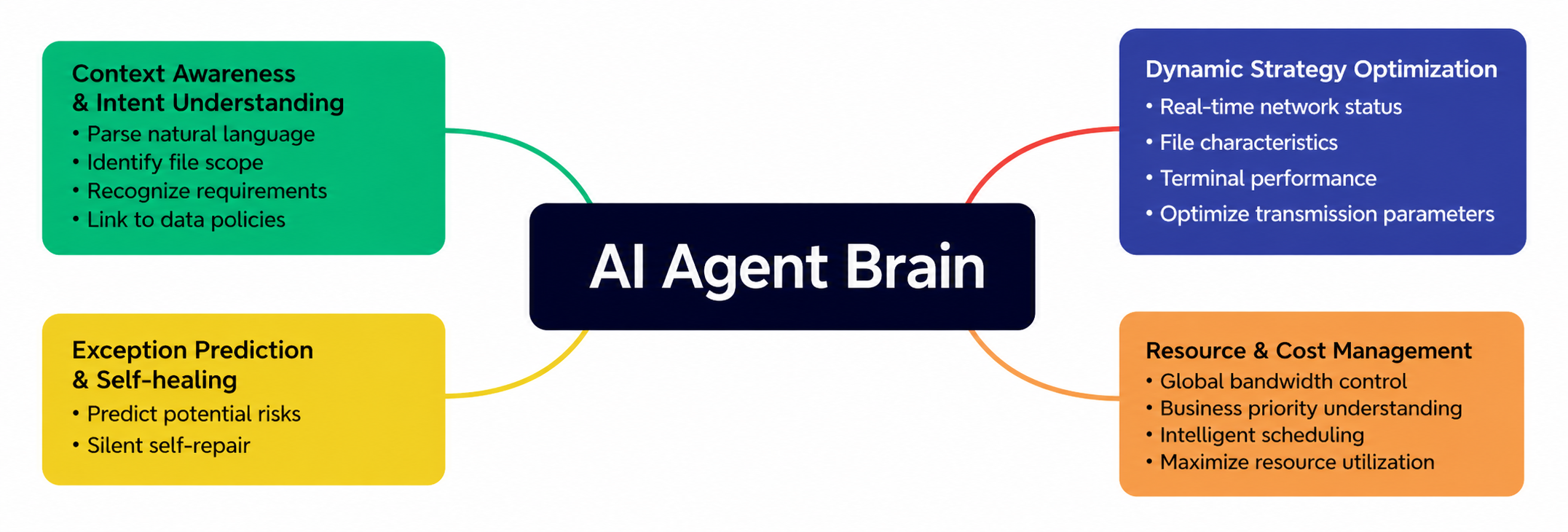
Raysync has bridged the gap to an intelligent future by packaging transfer wisdom—honed in complex enterprise scenarios—into Transfer Skills that an AI can understand and invoke.
Transfer Skills are not just lines of API code; they are a structured, industry-rich "Professional Skill Map". Think of it as the AI Agent’s "PhD" in file transfer, transforming it from an "intern" that follows simple commands into a "Transfer Expert" capable of independent operation.
This "Expert Brain" consists of four core modules:
-
Context Awareness & Intent Understanding: The AI Agent can parse natural language commands like, "Send all Q1 sales contracts securely to the auditor's account". It automatically identifies the file scope (Q1 contracts), destination (auditor), and core requirement (security).
-
Exception Prediction & Self-Healing: The Agent identifies and resolves anomalies automatically. For instance, if a transfer is hindered by a missing Python environment, it can seek alternative transfer methods or install the environment itself to complete the task. It matches fixes from hundreds of known solutions for "silent self-repair".
-
Resource & Cost Management: With a "God’s eye view," the AI Agent manages global bandwidth and understands the time-sensitive value of different business tasks. It sets priorities based on user needs, utilizing idle bandwidth for high-priority tasks to maximize ROI.
-
Evolutionary Skills: Through continuous self-learning and optimization (with user authorization), the Agent becomes more intelligent with every operation.
III. "Manual" vs. "Autonomous Driving"
A clear divide has formed in the market: those with AI Agent capabilities and those without.
Most traditional solutions remain at the "functional pile-up" stage. They may have resume-from-break or encrypted transfer, but these require manual configuration. When a transfer fails, engineers must analyze logs and adjust parameters—wasting valuable technical human resources.
In contrast, Raysync has achieved "Conversation as Operation". Employees no longer need to be network experts; they simply describe their needs in natural language, and the AI Agent translates them into the optimal transfer strategy.
One startup customer even used the Raysync AI Agent to coordinate code synchronization across three time zones, calling it their "Claude Moment"—referring to the natural way Anthropic’s Claude AI understands complex requirements. Much like Claude enables non-programmers to describe software needs, Raysync allows business staff without a technical background to describe transfer needs.
IV. Scenario Revolution: How the AI Agent Restructures Workflows
In practice, the Raysync AI Agent delivers value across various sectors:
-
Life Sciences: A researcher at a top gene sequencing center previously had to fill out long work orders and manually select dozens of folders for encrypted transfer. Now, they simply tell the AI Agent: "Send all influenza raw sequence data from 'Project Phoenix' generated last week to Professor Zhang’s team at Stanford using encrypted transfer and generate a compliance log". The Agent handles everything autonomously.
-
Film & Media: For a multinational co-production with assets in LA, London, and Beijing, a director needing color-grading materials no longer needs to know specific directories. They just say: "Sync all color-graded versions of Act 3 completed yesterday to my workstation," and the AI handles the rest via the director’s Raysync account.
-
Smart Manufacturing & R&D: In aerospace design, even a small delay can stall a production line. A design lead in Munich can simply instruct: "Immediately upload the latest 'RevC'承重结构 blueprints and change notes to the Alpha Project manufacturing server," and the AI Agent acts as the "critical path guardian".
V. Security and Control: The Foundation of Enterprise AI
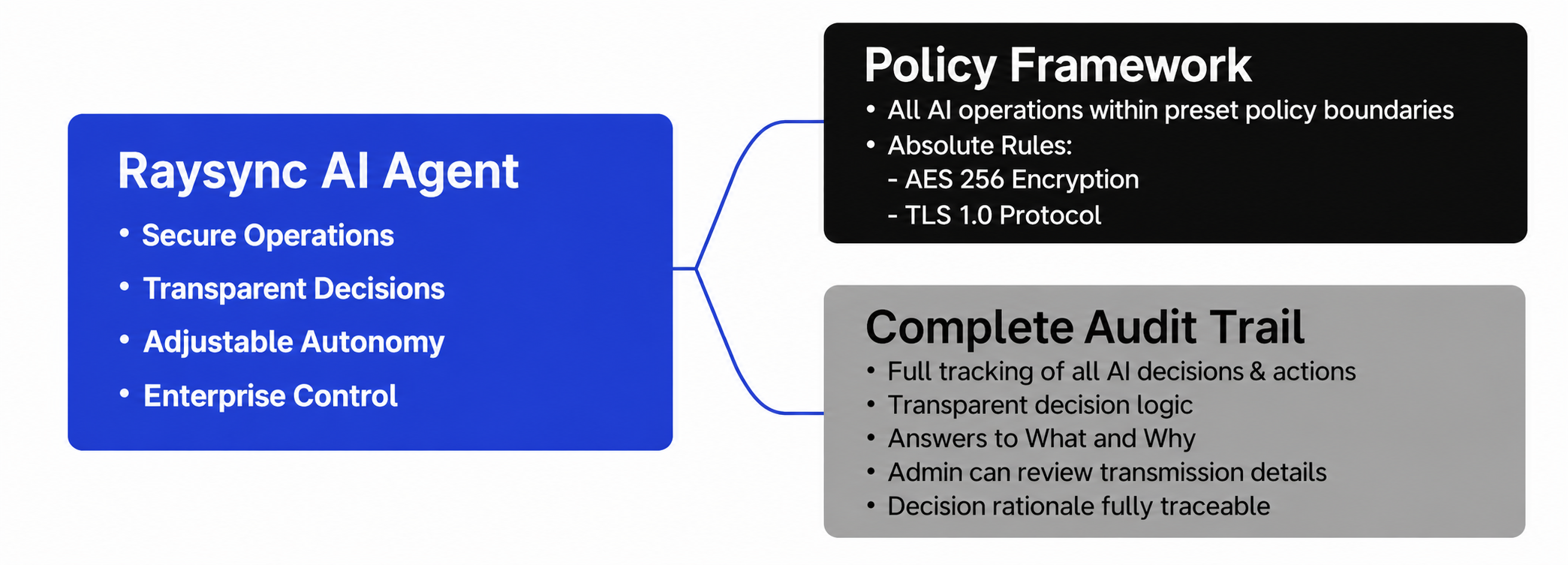
Raysync addresses the primary concern for enterprise AI—security—through a multi-layered design:
-
Preset Policy Framework: All AI operations occur within defined boundaries. Enterprises can set "Absolute Rules," such as mandatory AES-256 and TLS encryption.
-
Complete Audit Trails: Every decision and action is tracked. Admins can see not only what was transferred, but why the AI chose that specific logic, ensuring total transparency.
-
Adjustable Autonomy: Enterprises can choose the level of AI independence, ranging from "Full Auto" to "Suggest-and-Confirm" modes, maintaining a sense of control while enjoying AI convenience.
VI. The Future is Here: Every Enterprise Needs a "Transfer Agent"
Gartner predicts that by 2027, over 50% of large enterprises will deploy specialized AI Agents to handle specific business processes. File transfer, as the circulatory system of digital blood, is the ideal scenario for this technology.
Raysync’s vision is not just a "faster tool," but an Intelligent Hub for Enterprise Data Flow. Just as Claude is changing how we write code, Raysync’s AI Agent is changing how enterprises move data—shifting from "humans adapting to tools" to "tools understanding humans".
For solutions that have not yet embraced AI, the gap is no longer about features; it is a generational chasm. While competitors optimize algorithms, Raysync is redefining the very nature of "transfer". In this revolution, the question is no longer if you need AI, but when the AI Agent becomes your core data strategy partner.
Conclusion
The "data congestion" that has historically throttled global commerce is no longer an unavoidable tax on business; it is a problem with a definitive, intelligent solution. As enterprise architecture shifts from passive tools to the Raysync AI Agent, we are witnessing a paradigm shift from manual "data plumbing" to a world of "autonomous driving" for digital assets. By internalizing specialized Transfer Skills, Raysync allows enterprises to stop wasting their most valuable technical human resources on troubleshooting and start focusing on high-level innovation.
Industry trends confirm that this is not an isolated event. Gartner predicts that by 2027, AI agents will augment or automate 50% of business decisions. Crucially, the market is moving away from general-purpose models toward small, task-specific AI models that offer three times the accuracy and cost-efficiency for domain-level work—exactly the niche where Raysync’s specialized "Transfer Brain" operates. CIOs are now reframing file transfer from a background utility into a strategic integration concern that powers the success of every other major AI and data initiative.
Looking ahead, we are entering an era of Agentic Teamworking, where specialized agents for security, logistics, and data transfer collaborate seamlessly to manage entire business journeys end-to-end. In this future, the Raysync AI Agent serves as the intelligent circulatory system of the autonomous enterprise. This is more than an incremental upgrade; it is a generational leap from "people adapting to tools" to "tools understanding people". For the modern organization, integrating an intelligent transfer agent is no longer a luxury—it is the foundational requirement for thriving in an agent-powered world.