Top 5 LimeWire Alternatives for Secure, High-Speed File Sharing (2026)
July 10, 2024
TL;DR — Key Takeaways
- LimeWire shut down in 2010 following copyright lawsuits; the P2P file sharing market has since grown to $2.8 billion (2025) and is projected to reach $5.6 billion by 2034.
- µTorrent and qBittorrent are the most popular consumer BitTorrent clients — qBittorrent edges ahead on security and privacy.
- FrostWire forked directly from LimeWire and is still actively maintained — Android 3.0 launched in late 2025 — though its security model is weaker than qBittorrent's.
- Transmission is the cleanest, most lightweight option for Mac and Linux users.
- Raysync Enterprise is the only business-grade solution on this list — purpose-built for secure enterprise large file transfer with UDP acceleration, AES-256 encryption, and full compliance audit trails.
Peer-to-peer file sharing is not a relic of the early 2000s. The global P2P file sharing software market was valued at $2.8 billion in 2025 and is forecast to grow at a CAGR of roughly 8%, reaching $5.6 billion by 2034 (DataIntelo, 2024). BitTorrent remains the dominant P2P protocol by a wide margin, with over 170 million monthly active users and more than 2 billion installs across platforms (EarthWeb, 2024) — a scale that shows just how entrenched distributed file sharing has become in both consumer and enterprise workflows.
LimeWire was the gateway drug for a generation of file sharers. When it was shut down in October 2010 following a federal court injunction, millions of users needed to find a new home. Over a decade later, the question of "what's the best LimeWire alternative?" is still one of the most searched topics in the file sharing space — and the answer depends entirely on what you actually need.
This guide breaks down the best five LimeWire alternatives available in 2025, from lightweight consumer torrent clients to enterprise-grade secure transfer platforms, with honest comparisons on speed, security, and real-world performance.

The global P2P file sharing market is projected to nearly double from $2.8B to $5.6B by 2034. Source: DataIntelo, 2024. Alt text: Bar chart showing P2P file sharing software market growth from 2025 to 2034, rising from $2.8 billion to $5.6 billion
Why People Are Still Searching for LimeWire Alternatives
LimeWire's shutdown left a gap that no single platform has fully filled. Users miss its simplicity — a single search bar that surfaced music, videos, and software without juggling magnet links or tracker URLs. What they do not miss are the malware infections, legal grey areas, and the near-total absence of encryption.
Modern users searching for LimeWire-style platforms are really looking for a combination of things: easy discoverability of content, fast download speeds, a large pool of active seeders, and — increasingly — confidence that files are not carrying hidden payloads. Security has become table stakes. A 2025 review of BitTorrent-based clients found that legacy tools like µTorrent's free tier still bundle adware, while qBittorrent's open-source model has made it the security-conscious community's default choice (TechRadar, 2025).
For business users, the requirements shift entirely. Consumer P2P tools are built for downloading files, not for transferring 500GB datasets across geographies with full audit trails, encryption compliance, and guaranteed delivery. That is where enterprise large file transfer platforms like Raysync enter the picture.
Quick Comparison: Best LimeWire Alternatives at a Glance
| Tool | Best For | Open Source | Encryption | Enterprise-Grade | Platforms | Price |
|---|---|---|---|---|---|---|
| µTorrent | Speed & simplicity | No | Optional RC4 | ✗ | Win, Mac, Android | Free (ads) / Paid Pro |
| FrostWire | Cloud + torrent search | No | Optional RC4 | ✗ | Win, Mac, Linux, Android | Free |
| qBittorrent | Privacy-first consumers | ✓ Yes | Built-in encryption + IP filter | ✗ | Win, Mac, Linux | Free |
| Transmission | Minimalist Mac/Linux users | ✓ Yes | Built-in encryption | ✗ | Win, Mac, Linux | Free |
| Raysync Enterprise | Business & enterprise teams | No | AES-256 + TLS | ✓ Full | Win, Mac, Linux, Android, iOS | Contact for pricing |
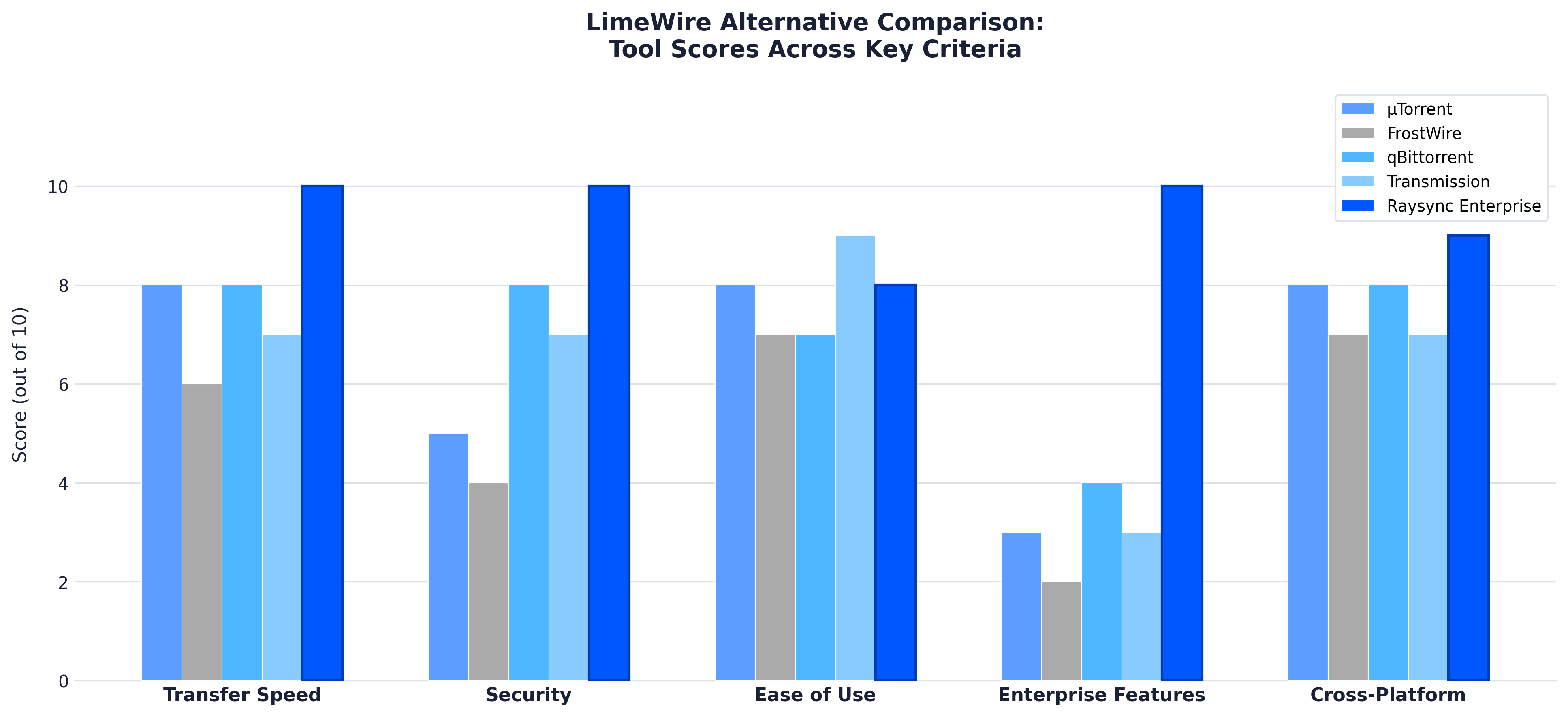
Side-by-side scores across five criteria: Transfer Speed, Security, Ease of Use, Enterprise Features, and Cross-Platform support. Raysync Enterprise leads on Security and Enterprise Features. Alt text: Grouped bar chart comparing five LimeWire alternatives — µTorrent, FrostWire, qBittorrent, Transmission, and Raysync Enterprise — across five criteria including security and enterprise features
The 5 Best LimeWire Alternatives in 2025
1. µTorrent — Fast, Familiar, and Widely Used
µTorrent has held the top position among BitTorrent clients for over a decade, and for good reason. It is lightweight (the installer weighs under 2MB), handles simultaneous downloads without choking slower machines, and supports scheduled downloads, bandwidth prioritization, and RSS feed integration for automated torrent grabs.
The interface will feel immediately familiar to anyone who used LimeWire — a clean list view, a built-in search bar, and straightforward category filters for music, video, and software. µTorrent is available on Windows, Mac, Linux, and Android, making it one of the most cross-platform options on this list.
The caveat is monetisation. The free tier includes persistent advertising, and multiple independent security reviews have flagged µTorrent's installer for bundling third-party software, including historically a cryptocurrency miner in some version releases. Users who want a clean, ad-free experience can upgrade to the paid Pro tier. For privacy-sensitive users, this is increasingly a reason to look elsewhere.
Best for: Casual downloaders who want broad compatibility and a familiar, speedy client.
2. FrostWire — The Direct LimeWire Descendant

FrostWire began as a literal fork of LimeWire's codebase, which makes it the most spiritually faithful alternative on this list. It combines BitTorrent downloading with a built-in search engine that indexes both torrent sites and cloud hosting platforms (SoundCloud, Archive.org, YouTube), giving users a single interface to search across multiple sources simultaneously.
The integrated media player — which allows streaming of partially downloaded files — is a standout feature that the pure BitTorrent clients lack. FrostWire is available on Windows, Mac, Linux, and Android.
Contrary to older reports, FrostWire is actively maintained. The Android client received a major 3.0 overhaul in November 2025 — two years in development — introducing BitTorrent v2 support, privacy improvements, and the removal of third-party ads. A follow-up 3.0.14 patch landed in December 2025 with additional stability fixes. The desktop version (7.0.2) introduced a VPN-Drop Protection system in 2025 to prevent identity exposure if a VPN connection drops mid-transfer.
The security model still lags behind qBittorrent's. FrostWire does not offer the same level of IP filtering, and its encryption relies on the same RC4-based BitTorrent MSE standard as other consumer clients — adequate for casual use, not sufficient for sensitive business data. Users on corporate machines should check with IT before installing any BitTorrent client.
Best for: Users who want LimeWire's multi-source search functionality across both torrents and cloud platforms in a single interface.
3. qBittorrent — The Security-Conscious Community's Pick

qBittorrent has quietly become the most respected BitTorrent client in the privacy and security community. It is fully open-source under the GNU GPL license, ships with zero advertising or bundled software, and has never been associated with the kind of monetisation controversies that have dogged µTorrent.
Technically, it punches above its weight. A built-in search engine (with plugin support for major torrent indexes), IP filtering to block known malicious peers, RSS feed automation, and sequential downloading for streaming-while-seeding are all included out of the box. Performance benchmarks consistently show qBittorrent matching or exceeding µTorrent on download speed, particularly on older or lower-spec hardware.
On security: qBittorrent supports the standard BitTorrent Message Stream Encryption (MSE) protocol to obfuscate transfer traffic, though BitTorrent's encryption uses RC4 cipher with an effective key strength of 60–80 bits — significantly weaker than the AES-256 standard used by enterprise-grade transfer platforms. It is worth noting that version 5.0.1 (October 2024) patched a remote code execution vulnerability related to TLS certificate validation; the open-source team identified and closed it promptly, which is precisely the advantage of community-audited code. For consumer file sharing, qBittorrent's security posture is strong; for regulated business data, it is not the right tool.
Best for: Privacy-first users who want a capable, ad-free client with no trust concerns about the software itself.
4. Transmission — Minimalist and Rock-Solid
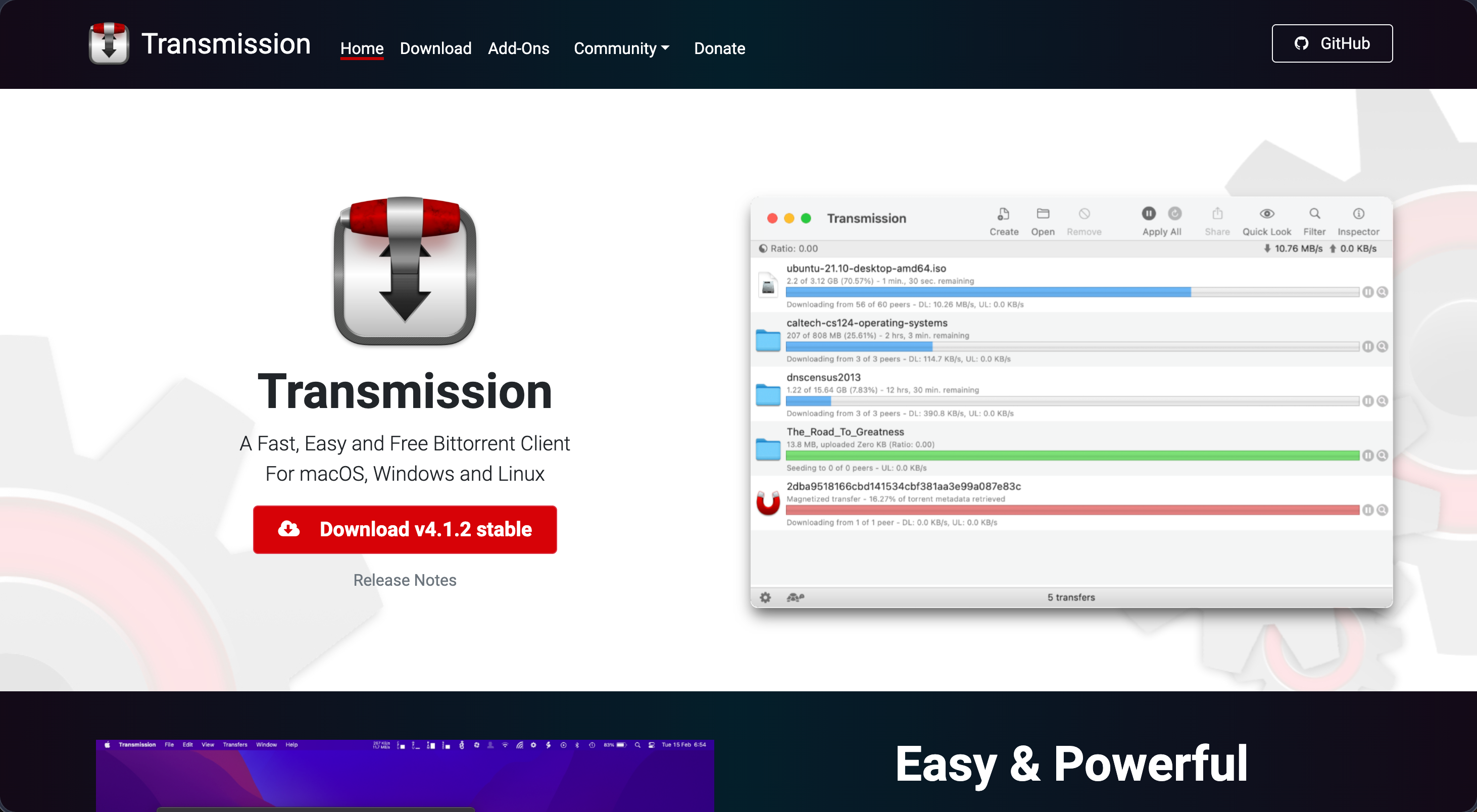
Transmission occupies a unique niche: it is deliberately simple. The interface has barely changed in years, and that is a feature, not a bug. There are no ads, no plugins to manage, no feature bloat — just a lightweight, reliable BitTorrent client that stays out of your way.
Under the hood, Transmission handles the essentials well: built-in encryption, web seed support for faster downloads from HTTP sources, peer exchange (PEX), magnet link support, and a web interface for remote management (particularly useful on headless Linux servers and NAS devices). The bandwidth control is granular, allowing per-torrent speed limits without affecting global settings.
Transmission is the default choice for many Mac users and a staple on Linux home servers and Raspberry Pi builds. It is also available on Windows, though the Linux and macOS versions have historically received faster updates. If you want something that just works, with no configuration rabbit holes, Transmission is the answer.
Best for: Mac/Linux power users, NAS setups, and anyone who wants zero bloat and reliable background downloading.
5. Raysync Enterprise — Secure Enterprise Large File Transfer
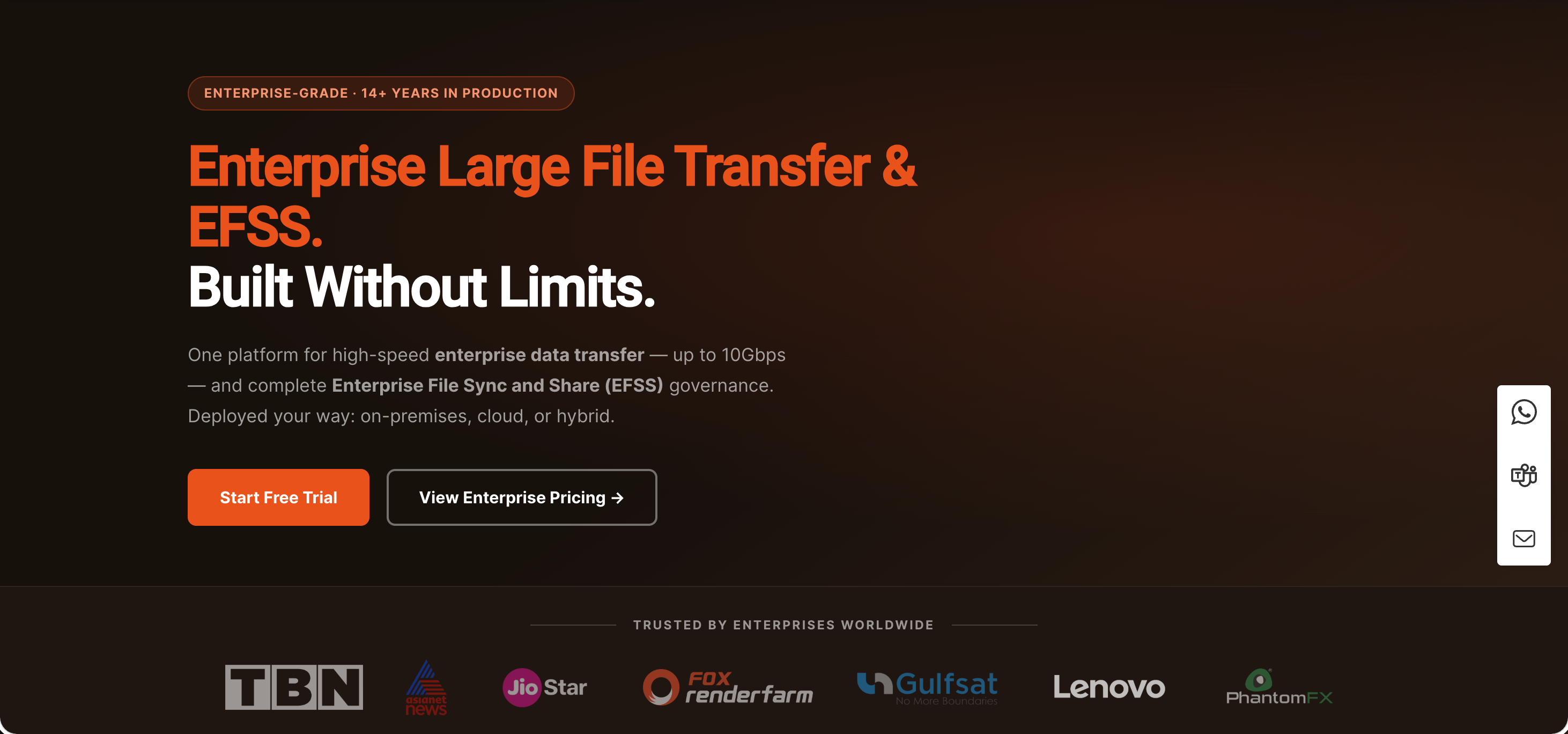
Raysync sits in a different category from the four tools above. Where µTorrent, qBittorrent, FrostWire, and Transmission are consumer-oriented BitTorrent clients optimised for downloading publicly shared content, Raysync Enterprise is a purpose-built enterprise large file transfer platform designed for organisations that need to move critical data fast, securely, and with complete auditability.
The fundamental architectural difference comes down to transport protocol. Consumer BitTorrent clients run on TCP, which degrades significantly on high-latency and high-packet-loss connections — conditions that are the norm on cross-border and intercontinental links. Raysync's proprietary UDP-based acceleration protocol maintains up to 95% bandwidth utilisation even at 200ms+ RTT, while standard TCP-based transfers drop to 10–20% efficiency under the same conditions (Hivenet, 2025). For an enterprise moving 100GB datasets from Singapore to Frankfurt, that gap translates to hours versus minutes.
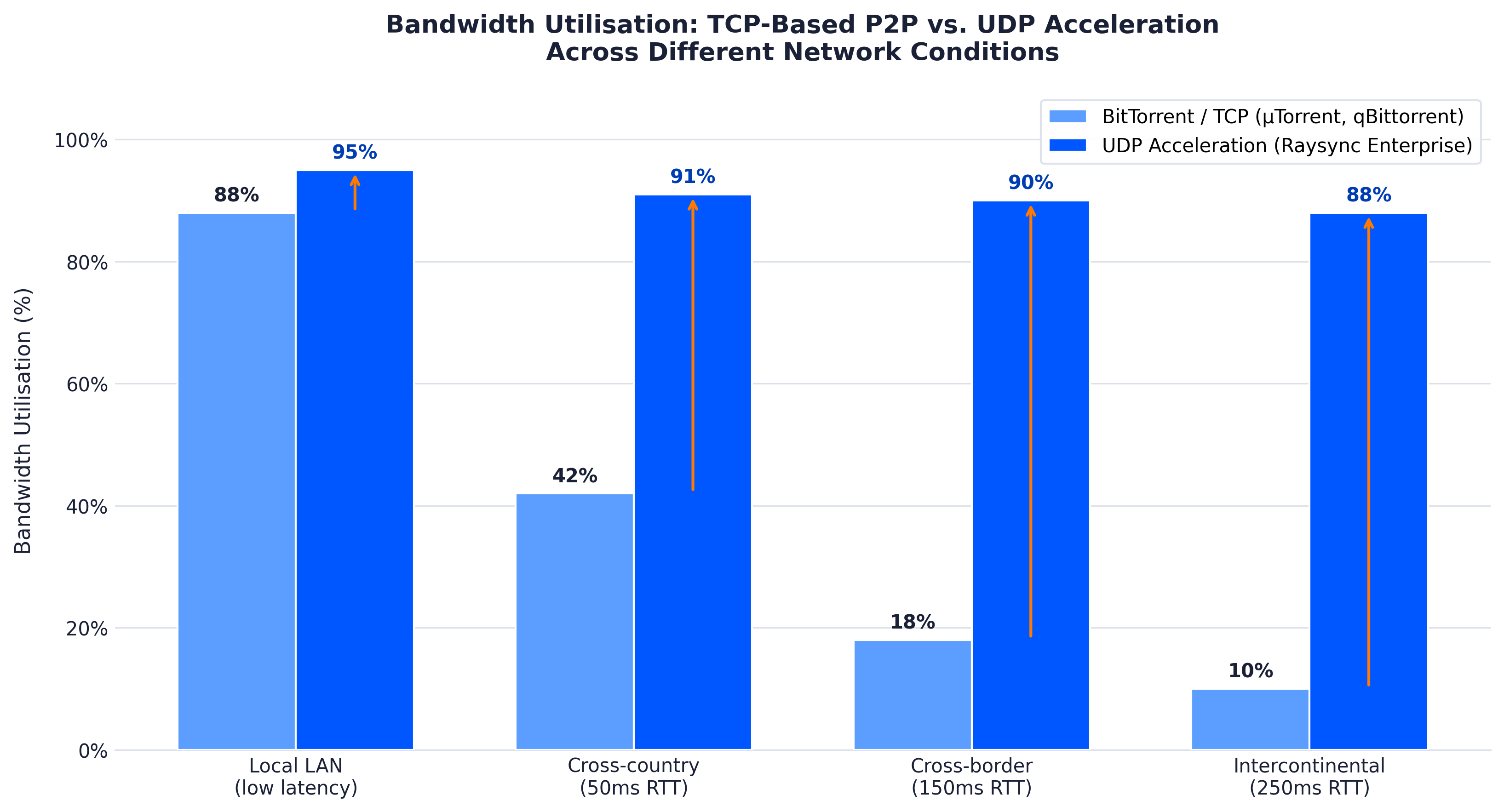
Raysync's UDP acceleration maintains ~90% bandwidth utilisation across all network conditions. TCP-based BitTorrent clients drop to 10–18% efficiency on intercontinental routes. Alt text: Grouped bar chart comparing bandwidth utilisation of TCP-based P2P tools versus Raysync UDP acceleration across local, cross-country, cross-border, and intercontinental connections
Why enterprise teams choose Raysync Enterprise over consumer P2P tools:
- Up to 10Gbps transfer speed — 100× faster than FTP, regardless of distance or packet loss, via Raysync's proprietary UDP-based WAN protocol
- AES-256 + TLS encryption end-to-end — not the 60–80-bit RC4 used by BitTorrent MSE
- HIPAA and TPN certified — with GDPR-ready architecture; immutable audit logs exportable for compliance reviews
- Centralised user and permission management — IT admins control who can send, receive, and access files via a single admin console with full RBAC
- Guaranteed delivery with automatic checkpoint resume — transfers pick up exactly where they left off after any interruption, with no file size limits
- No reliance on third-party trackers or peers — transfers go node-to-node via authenticated endpoints, not public swarms
- Deep enterprise integration — REST API, SDK, and CLI; native SSO with Active Directory, LDAP, Okta, OneLogin, and Google Workspace
- Bandwidth-based licensing — unlimited users on each license tier, with no per-seat pricing walls
- 14+ years in enterprise production — trusted by organisations in media & entertainment, life sciences, financial services, manufacturing, and gaming worldwide
The Raysync Enterprise plan is the flagship tier, combining high-speed enterprise large file transfer with a full Enterprise File Sync and Share (EFSS) governance layer — automated sync, centralised control, secure sharing, and compliance audit trails on one deployable platform (on-premises, cloud, or hybrid). Enterprise customers use it to replace legacy FTP/SFTP workflows and handle the throughput demands of modern AI data pipelines, broadcast content distribution, genomics data movement, and cross-border CAD file collaboration.
If your use case involves sharing files with friends or downloading Linux ISOs, one of the four consumer clients above will serve you well. If your use case involves moving business-critical data across regions, with security and compliance requirements attached, Raysync Enterprise is in a different league.
Watch the video guide to see how to operate p2p file share on Raysync:
A Brief History of LimeWire

LimeWire launched in May 2000, developed by Lime Wire LLC and built on the decentralised Gnutella network. At its peak, it claimed over 50 million users and dominated casual music and file sharing in the pre-streaming era. Its appeal was simple: type a song name, press search, get results. No registration, no payment, no friction.
That frictionlessness was also its legal undoing. The Recording Industry Association of America (RIAA) and numerous major labels pursued LimeWire through the courts for years, arguing that the platform's core design facilitated massive copyright infringement. In October 2010, a U.S. federal court issued an injunction ordering LimeWire to disable its file-sharing functionality. The service shut down the same month.
A U.S. federal court ruled LimeWire liable for inducement of copyright infringement in May 2010. Lime Wire LLC settled with 13 major record labels on May 12, 2011 for $105 million — well short of the $1.4 billion originally sought (The Register, 2011). The shutdown marked the end of the Gnutella era for mainstream users, pushing the file-sharing community toward BitTorrent — a more resilient, decentralised protocol that remains the dominant P2P standard today.
Frequently Asked Questions About LimeWire Alternatives
What is the modern equivalent of LimeWire?
The closest modern equivalent for casual users is qBittorrent — it is free, open-source, and offers a built-in search engine that indexes public torrent sites, replicating LimeWire's core "search and download" experience without the legal and malware baggage. For enterprise teams requiring secure, fast, and compliant file transfer, Raysync Enterprise is the modern answer.
Is there a safe LimeWire alternative that won't install malware?
Yes. qBittorrent and Transmission are both open-source, carry no advertising, and have clean security track records. µTorrent's free tier bundles adware; if you use it, opt out of all optional installs during setup. FrostWire is actively maintained as of 2025, but its security model (RC4-based encryption, no IP filtering) is weaker than qBittorrent's. None of these client applications are inherently malicious, but the files you download via them can be — always scan downloads with an up-to-date antivirus tool.
Does LimeWire still work in 2025?
No. LimeWire was permanently shut down in October 2010 following a federal court injunction. The original software is non-functional. There is a separate "LimeWire" brand that re-emerged as an NFT marketplace, but it has no connection to the original file-sharing software.
Which LimeWire alternative is best for Android?
µTorrent for Android has the widest install base and the smoothest mobile experience. FrostWire for Android supports both torrent and cloud downloads in a single interface. For enterprise mobile use cases, Raysync offers a cross-platform solution with mobile web access.
What came after LimeWire?
FrostWire, which forked directly from LimeWire's codebase, was the most immediate successor. The broader P2P ecosystem pivoted to BitTorrent clients — µTorrent, Vuze, and later qBittorrent — which offered more resilient downloading through distributed tracker networks. Streaming services (Spotify, Netflix) absorbed much of the casual media consumption that LimeWire once served.
What is the best LimeWire alternative for businesses?
For business use, consumer BitTorrent clients are not appropriate — they lack access controls, audit logging, encryption compliance, and the performance guarantees that enterprise data workflows require. Raysync Enterprise is purpose-built for this context, offering UDP-accelerated enterprise large file transfer with AES-256 encryption, centralised management, and compliance-ready reporting across global enterprise deployments.
How does Raysync compare to consumer P2P tools on speed?
On local networks, the difference is minimal. On cross-border or intercontinental transfers — which is where enterprise teams actually work — the gap is substantial. Consumer BitTorrent clients using TCP typically achieve 10–20% bandwidth utilisation on high-latency connections (150ms+ RTT). Raysync's UDP acceleration maintains 88–95% utilisation across the same routes. For a 100GB transfer on a 1Gbps intercontinental link, that is roughly the difference between 14 minutes and 2.2 hours.
Conclusion: The Right Alternative Depends on What You're Actually Transferring
LimeWire's legacy is complicated: it democratised access to digital content and introduced a generation to P2P sharing, but it did so at the cost of security and legal certainty. Its successors have learned from that history.
For casual users, qBittorrent is the standout recommendation — free, private, fast, and genuinely trustworthy. Transmission is the better pick if simplicity matters more than features. µTorrent remains a solid option if you are comfortable managing its ad-bundled installer. FrostWire is worth considering if its multi-source search across torrents and cloud platforms is a hard requirement — it is actively maintained and improved, but offers less privacy control than qBittorrent.
For enterprises, the conversation is different. If your team moves large files across borders — whether it is media assets, genomics data, financial records, or AI training datasets — a consumer P2P client is not a tool, it is a liability. The Raysync Enterprise plan gives you the performance of accelerated enterprise large file transfer, the security posture that compliance frameworks require, and the centralised control that IT teams actually need.
You might also like
Industry news
June 14, 2024Learn all about enterprise file sync and share EFSS solutions and discover the top EFSS options, their features, pricing, and user feedback to choose the best fit for your enterprise needs.

Industry news
April 30, 2026Raysync or MASV for enterprise large file transfer? We compare speed, security, pricing, and deployment so you can choose the right tool for your workflow.
![Top 4 Cloud Based SFTP Online Solution [Fast Setup]](http://images.ctfassets.net/iz0mtfla8bmk/2HUgLJNWRfGb8PUoKXozRm/6da914dd37eb7b7b8fec5fd3c552a3c5/cloud-based-sftp.png)
Industry news
July 25, 2024In this blog post we will look at the top cloud-based SFTP tools for efficient large file sharing and discover how these tools enhance speed and security for remote file transfers.